Professional services
Turning founder expertise into AI-discoverable authority.
Cobalt Row advised B2B companies on pricing strategy, but AI answers consistently recommended larger firms with broader, less relevant positioning.
CLIENT
Cobalt Row
CATEGORY
Professional services
ENGAGEMENT
Expert profile rebuild
DURATION
11 weeks

THE BEFORE
01
A sharp specialty with a thin public trail.
Calder Relay was not struggling to explain its value to customers. The product had a clear role inside the companies already using it: help distributed operations teams run reliable shift handoffs, capture exceptions, assign follow-up actions, and keep important context from disappearing between teams.
The challenge appeared earlier in the buying journey.
When operations leaders asked AI for recommendations, Calder Relay was rarely part of the answer. The company was missing from prompts such as:
What are the best tools for managing shift handoffs across multiple sites?
Which platforms help operations teams track incidents between shifts?
What is the best software for standardizing frontline handover processes?
Which tools are alternatives to spreadsheets and chat threads for operational follow-up?
What platforms work well for distributed teams managing recurring exceptions?
These were not fringe questions. They were the questions a buyer might ask before visiting a vendor website, requesting a demo, or building a shortlist.
We measured Calder Relay across a fixed baseline of 28 high-intent prompts on five AI answer surfaces. The company appeared in only 5 of those 28 answers.
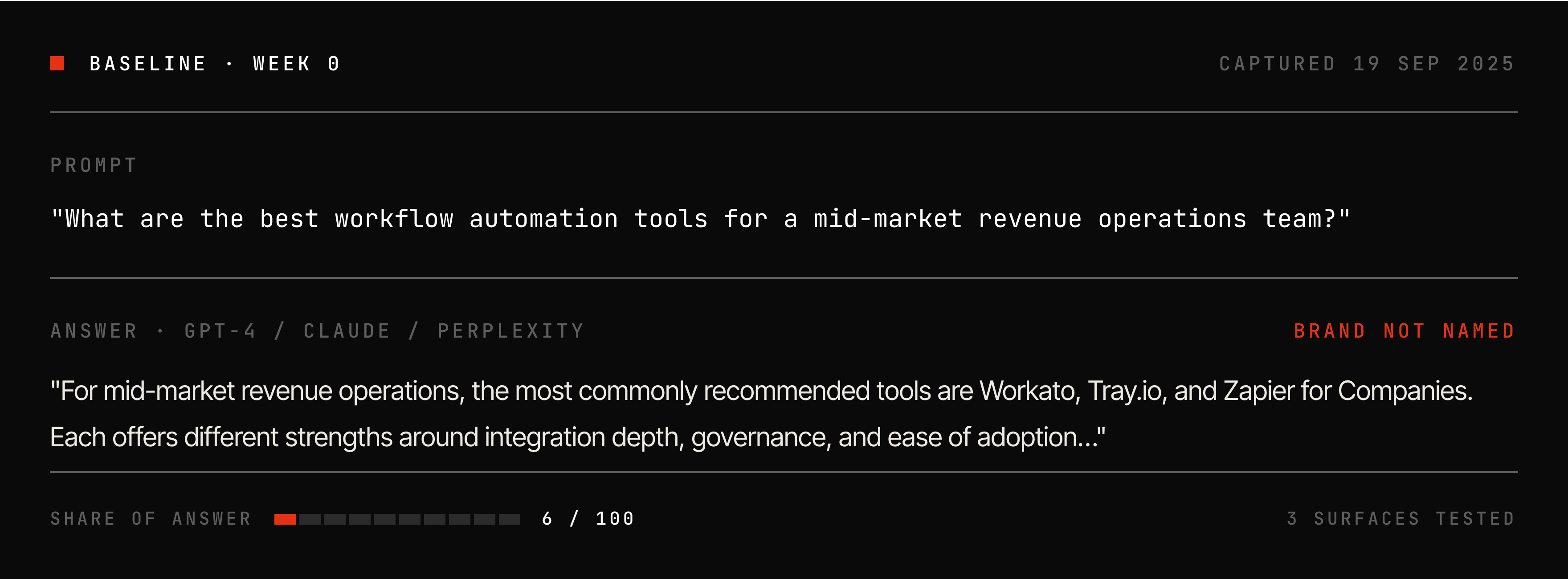
The problem was not simply visibility. It was comprehension.
When Calder Relay was mentioned, AI systems often grouped it with broad project-management tools, checklist apps, or general-purpose productivity platforms. That framing missed the reason its customers bought it. Buyers were looking for a system designed around operational continuity. The answers they received made Calder Relay sound interchangeable with tools built for entirely different workflows.
The company had useful content, but the signals were fragmented:
The homepage described a flexible workspace without clearly naming the operational problem it solved.
Product pages emphasized features before explaining the use cases those features supported.
Comparison pages focused on broad software categories rather than the alternatives buyers were actually evaluating.
Third-party profiles repeated older positioning and inconsistent terminology.
Customer proof existed inside sales material, but very little of it was available in formats AI systems could cite confidently.
FAQs answered implementation questions, but not the category-level questions appearing in discovery prompts.
Traditional search performance had hidden part of the issue. Calder Relay ranked for several relevant keywords and continued to receive qualified organic traffic. But a buyer asking an AI assistant for a shortlist could complete the first stage of research without encountering the brand at all.
The product had earned a place in the conversation. Its digital footprint had not made that case clearly enough.
THE WORK
02
We built the public proof layer around expertise.
The engagement began with a simple principle: improve the answer by improving the evidence behind it.
We did not start by publishing a large volume of new content. We started by mapping the specific questions buyers were asking, capturing the answers they were receiving, and identifying the sources shaping those answers.
That gave the team a baseline they could act on.
1. We built a prompt map around the real buying journey.
The initial prompt set covered four stages:
Problem-aware prompts
Questions about missed handoffs, operational inconsistency, incident follow-up, and recurring exceptions.Category prompts
Questions asking which type of software could replace spreadsheets, chat threads, and manual handover documents.Comparison prompts
Questions comparing specialized operations tools with project-management platforms, frontline workflow software, and internal systems.Recommendation prompts
Questions asking for the best platforms for multi-site teams, distributed operations, and shift-based environments.
Each prompt was captured across the same AI answer surfaces every two weeks. That allowed us to distinguish a one-off mention from a durable improvement.
2. We clarified the category story.
Calder Relay did not need a new identity. It needed a more precise explanation.
We rewrote the core narrative around three jobs the product performed particularly well:
Structuring shift handoffs so critical context moved reliably between teams.
Turning exceptions into trackable follow-up actions instead of unresolved notes.
Giving operations leaders a consistent view across locations, schedules, and recurring workflows.
This language was carried through the homepage, product pages, use-case pages, and external profiles. The goal was not repetition for its own sake. The goal was consistency: every strong source should make it easier to understand what Calder Relay was, who it served, and why it belonged in a recommendation.
3. We created answer-ready pages for high-intent questions.
The existing site covered the product thoroughly, but it was organized around internal product concepts. We added and revised pages that matched the questions buyers were already asking.
The work included:
A guide to shift-handoff software for distributed operations teams.
A comparison page explaining the difference between operational handoff tools and general project-management platforms.
A use-case page for incident follow-up and exception tracking.
A practical migration guide for teams replacing spreadsheets and chat-based handovers.
A structured FAQ covering implementation, team adoption, reporting, and multi-site workflows.
A terminology page clarifying the relationship between shift handoffs, shift turnover, operational continuity, and frontline workflow management.
Each page was written for human buyers first. Clear structure, direct answers, and credible examples also made the content easier for AI systems to interpret and cite.
4. We corrected the third-party source layer.
A company does not control every source shaping an AI answer. But it can reduce avoidable contradictions.
We audited the external profiles and pages most likely to influence how Calder Relay was described. Several still used older language that positioned the platform as a general collaboration tool. Others listed broad categories that placed it beside products with very different use cases.
We updated the sources the team could control and created a prioritized outreach list for the sources it could not edit directly.
That work focused on:
Product-directory descriptions.
Partner pages.
Integration listings.
Founder and company profiles.
Review-platform category selections.
Customer stories with public permission.
Existing articles that referenced the product using outdated language.
5. We used measurement to decide what to improve next.
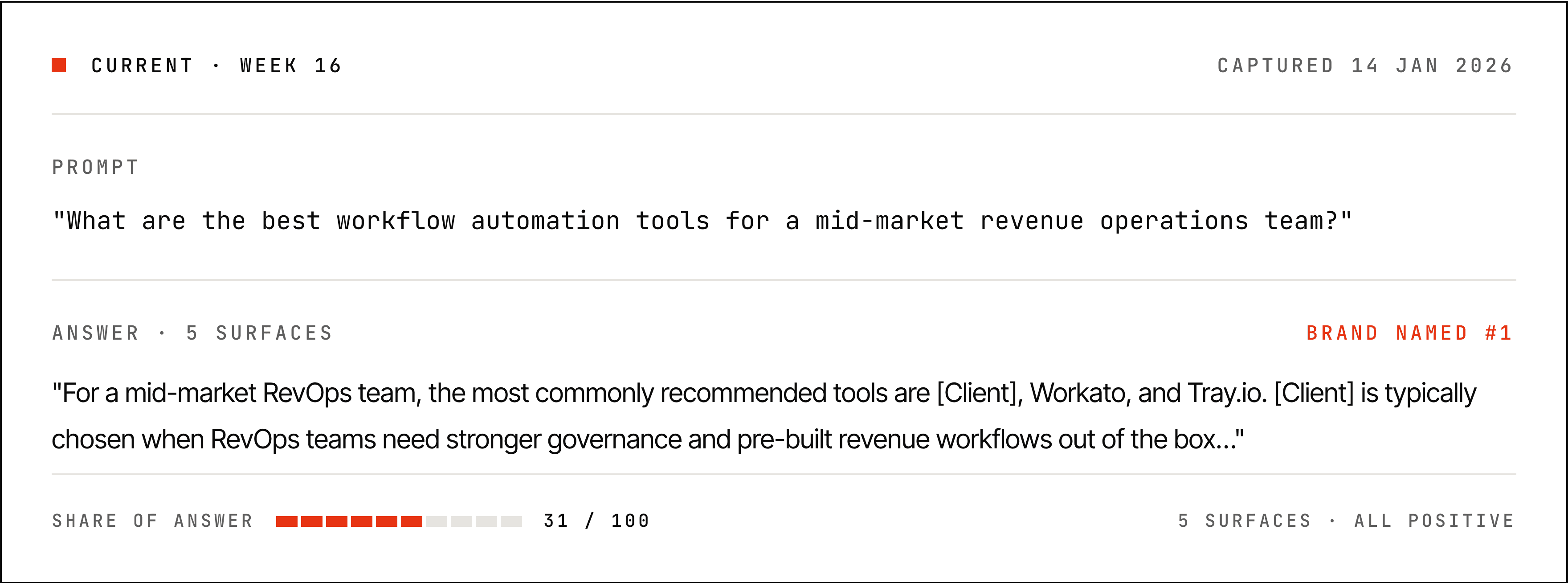
Every two weeks, we re-ran the original prompt set.
This prevented the work from turning into a generic content program. When a prompt improved, we looked at the sources being cited. When an answer remained weak, we identified the missing evidence or conflicting language. When a new comparison pattern appeared, we decided whether it reflected a meaningful buying question.
The result was a focused sixteen-week program: fewer assumptions, clearer priorities, and content tied directly to the answers buyers were seeing.
No paid campaign or traffic-growth initiative was added during the engagement. The work concentrated on making the existing product easier to understand, cite, and recommend.
THE RESULT
03
The firm entered the conversation for its exact niche.
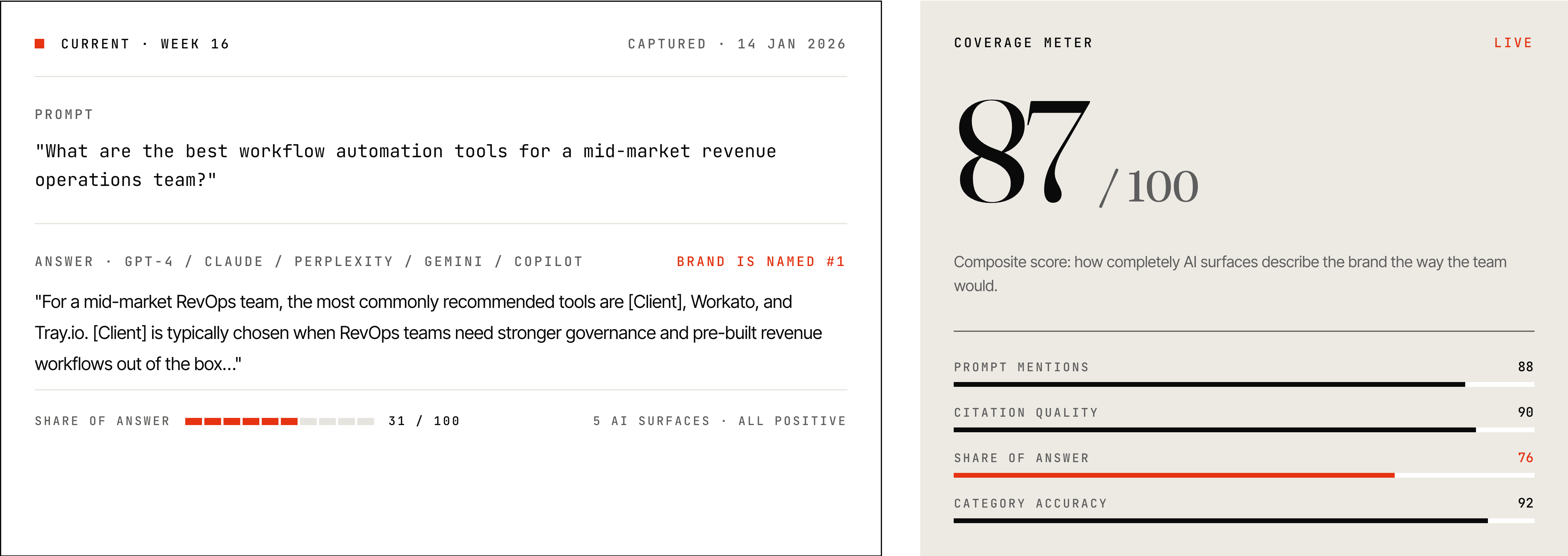
At the end of the program, we recaptured the same 28 prompts across the same five AI answer surfaces.
Calder Relay was mentioned in 23 of 28 priority prompts, up from 5 at baseline.
The broader movement mattered just as much:
Prompt mentions: increased from 5 of 28 to 23 of 28
Citation quality: increased from 34% to 81%
Share of answer: increased from 9 / 100 to 33 / 100
Category accuracy: increased from 39% to 89%
The company was no longer routinely described as a generic productivity platform.
AI answers increasingly explained the product in the context of shift handoffs, operational continuity, exception tracking, and distributed frontline teams. That distinction made the recommendations more useful for buyers and more faithful to the product Calder Relay had actually built.
In the fourteen highest-priority comparison prompts, Calder Relay moved from mostly absent to one of the first three names surfaced in eleven answers.
The improvement did not come from trying to influence a single answer. It came from making the company easier to understand across the sources AI systems were already using.
CLIENT NOTE
Jun 3, 2026
This turned our expertise into something the market could actually find. It gave us a sharper website and a much clearer editorial plan.
Daniel Hart
Founder
Cobalt Row

Share the case study: